Introduction: Start With the Application
LED lighting can serve many purposes, from illuminating a shop sign to creating subtle architectural accents. However, different projects require different lighting characteristics. Brightness, voltage, flexibility, waterproofing, installation space, and light distribution can all affect the final result.
Choosing the right component starts with understanding where the lighting will be installed and what type of illumination the project needs. A flexible strip may suit a narrow cove, while a module can be more appropriate for signage or backlighting. Looking at the technical details before installation can also prevent problems with power, heat, and uneven illumination.
Match the Lighting to the Project
The first step is to define the purpose of the lighting. Cove lighting, architectural features, signage, display cases, pathways, and decorative installations can have very different requirements.
For example, a flexible LED strip can follow curved surfaces and fit into narrow spaces. A product with suitable waterproof protection can also be considered for areas exposed to moisture. IP65 and IP68 options are available for applications where additional protection is required.
The installation area also matters. Measure the available space and determine how much light is needed before selecting the LED type. This makes it easier to choose suitable voltage, LED density, power consumption, and cutting length.
What to Consider When Selecting LED Strip Lighting
Technical specifications provide useful information when comparing products from different LED Strip suppliers. Look at the number of LEDs per meter, maximum power, voltage, color temperature, PCB dimensions, cutting length, and protection rating.
For instance, a 5050 strip can contain 300 LEDs across a five meter reel, with a maximum power of 17W per meter depending on the model. Some versions offer IP65 or IP68 protection. Other products use 3528 or 2835 LEDs for different brightness and power requirements.
Cutting flexibility can also influence installation. Some 24V strips can be cut at specific intervals, while accessories allow sections to be connected again. Products with adhesive backing can simplify installation on suitable clean surfaces.
It is equally important to check the power supply before connecting a strip. The voltage must match the LED system. Incorrect voltage can affect performance and may damage the lighting.
Understanding LED Modules for Signage and Backlighting
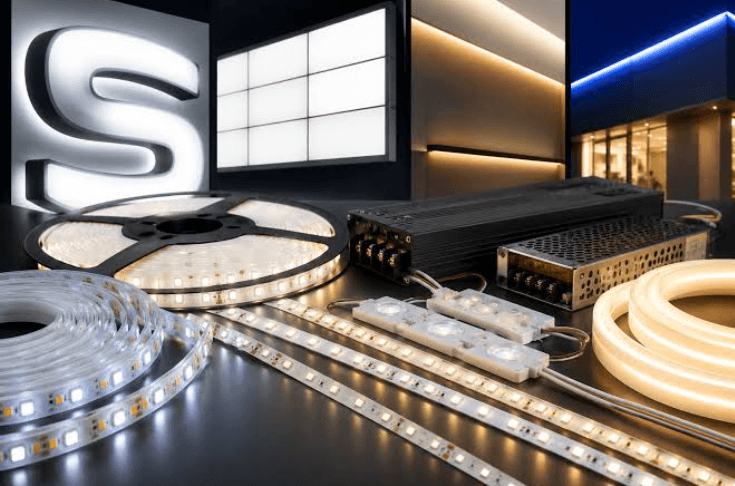
Signage and backlighting often require controlled light distribution across a defined surface. An LED Module can be useful in applications such as channel letters, light boxes, advertising displays, and backlit panels where individual light points can be positioned according to the required layout.
Unlike a continuous flexible strip, modules can be arranged across a surface to help distribute illumination where it is needed. The spacing between modules, mounting position, brightness, and distance from the illuminated surface all influence the final appearance.
For signage work, these factors are important because uneven spacing can create visible dark areas. Before installation, consider the depth of the sign, the material being illuminated, and the required brightness.
LED Strips and Modules Serve Different Purposes
LED strips and modules can overlap in some applications, but they have different installation characteristics.
LED strips are flexible and useful where lighting needs to follow a line, edge, curve, or narrow channel. They are commonly used for cove lighting, architectural features, furniture, windows, corridors, and decorative installations.
Modules are more suited to applications where light sources need to be distributed across a surface. This makes them particularly useful for signage and backlighting.
The choice should therefore depend on the shape of the installation, desired light distribution, available space, and maintenance requirements rather than simply choosing the brightest option.
Pay Attention to Voltage and Power
Voltage is one of the most important specifications to check. Common LED systems use 12V or 24V DC, while some specialized products operate at other voltages.
A 24V system can help reduce voltage drop over longer runs compared with a 12V system. With excessive voltage drop, brightness can decrease toward the end of a long strip. Proper power planning helps maintain more consistent illumination.
Power consumption should also be calculated before installation. If a strip uses 12W per meter and the installation requires several meters, the total load should be considered when selecting the power supply. Controllers must also support the required voltage and current.
Consider Environmental Conditions
Indoor installations generally have fewer environmental concerns, but outdoor and damp locations require more attention. Check the IP rating before choosing a product for an exposed area.
A waterproof strip may be appropriate for locations where moisture is expected. IP65 and IP68 products offer different levels of protection, so the rating should match the actual installation environment.
Temperature also matters. Good installation practices can help manage heat, especially for higher-power LED products. Aluminum profiles or suitable mounting surfaces can assist with heat dissipation and provide a cleaner installation.
Look at Light Quality and Installation Details
Brightness alone does not determine whether an LED system will look good. Color temperature, color rendering, beam angle, LED spacing, and light uniformity can all affect the result.
For example, a 5050 RGBW strip can combine RGB colors with warm white, providing different lighting possibilities. Some warm white versions offer color temperatures around 2700K to 3000K, which can create a warmer appearance.
COB LED strips are another option when a continuous appearance is preferred. Their closely positioned light sources can reduce the visible spotting sometimes associated with conventional SMD strips.
Make the Selection Based on Specifications
A practical selection process can save time during installation. First, identify the application and measure the available area. Then determine the required brightness, voltage, color, and protection level.
Next, check the power requirement and make sure the power supply and controller can handle the total load. Finally, review cutting points, connectors, mounting methods, and heat management requirements.
Shenzhen Dekingled Co., Ltd. was established in 2014 and operates from SanMing Industrial Park in Shenzhen, China. The company provides technical support alongside its LED lighting products.
The company lists fast delivery, cost-effective solutions, top quality, and technical support among its service advantages. These details can be useful when evaluating suppliers for projects with specific technical requirements.
See also: How AI-Powered Soundboxes Are Transforming Business Operations in India
Final Thoughts
Selecting LED lighting is mainly about matching the component to the installation. Strips can provide flexible linear illumination, while modules can offer practical solutions for signage and backlighting. Voltage, power, waterproofing, brightness, cutting length, and light distribution should all be considered before installation.
A careful review of these specifications can help you choose a lighting system that fits the physical space and performs consistently for its intended application.