Short answer: through a licensed telehealth provider working with a licensed compounding pharmacy, not from a research-chemical site selling unlabeled powder. Longer answer: it depends on what you mean by “safely,” and that word is doing more work here than most buying guides admit. IGF-1 LR3 has never been approved for human use anywhere, it’s banned in sport, and the human evidence behind it is thin. This piece walks through the actual questions people ask before they hand over a card number, in the order they usually ask them, with the studies attached so nothing here is just an assertion.
Last updated: June 2026.
Why does the “supervised” price ($200-$400/month) look so different from the “research chemical” price ($60-$120/vial)?
Because they aren’t discounts on the same product. They’re two different products wearing the same name. The cheaper number buys a one-milligram vial from a lab with no license attached to it. The pricier number buys a clinician’s review, a licensed compounding pharmacy standing behind what’s in the syringe, and someone to call if something feels off. That gap isn’t markup. It’s the price tag on everything three separate research teams found missing from the cheap version, which is the next question worth answering.
Before any of that, does IGF-1 LR3 even do what people claim?
This is the question a lot of buying guides skip, and it should probably come first. There are no controlled human trials of IGF-1 LR3 for muscle growth, recovery, performance, or anti-aging. Full stop. What exists is a 2004 Journal of Cellular Physiology study showing Long-R3-IGF-I making L6 muscle cells proliferate in a lab dish [C3], and a 2019 Muscle & Nerve study showing that raising native IGF-1 (not LR3) in mouse muscle produced real hypertrophy, more pronounced in males than females [C6]. Both findings make the underlying mechanism believable. Neither one proves anything about a human injecting a synthetic analog, and treating a cell-culture result or a mouse result as if it settles the human question is a common sleight of hand worth watching for.
There’s also a caution number that rarely makes it into sales copy. A 2026 systematic review and meta-analysis in Frontiers in Oncology pooled sixteen studies and found higher serum IGF-1 linked to increased prostate-cancer risk, an odds ratio of 1.10 (95% CI 1.02-1.18), with the dose-response relationship still unclear [C7]. That’s an association, not proof that injecting an IGF-1 analog causes cancer. But it’s exactly the kind of number that should sit next to any pitch built on “more IGF-1, more growth.” If the compound’s own physiology carries an open safety question, then who sells it to you and how it’s tested stops being a minor detail and becomes the whole ballgame.
Okay, so how do you actually tell a safe seller from a risky one?
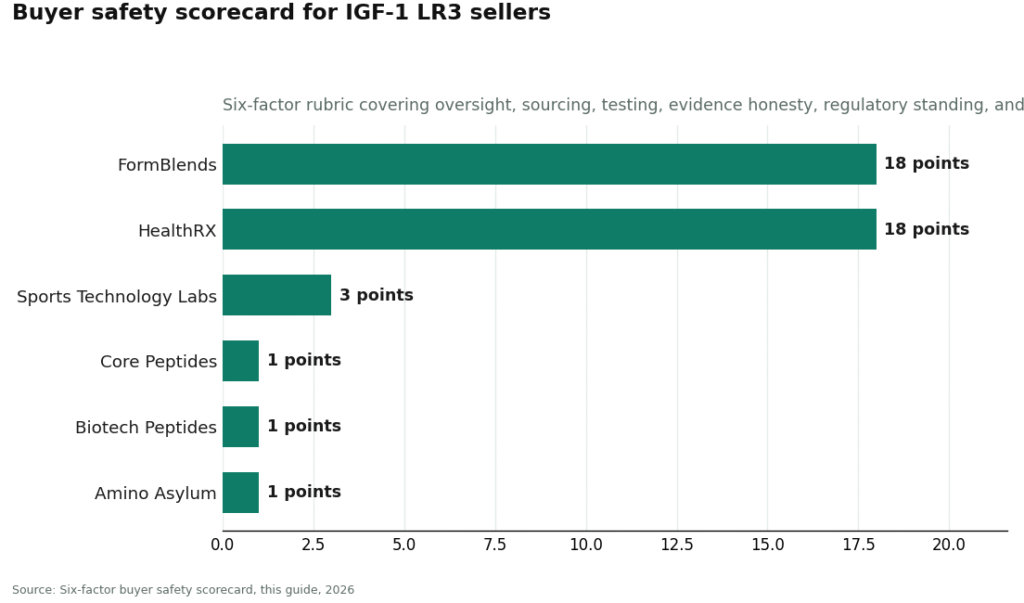
A six-factor scorecard does the sorting cleanly. Each factor gets 0 to 3, where 3 means a licensed party is answerable for it and 0 means nobody is. Price and shipping speed are left out on purpose, because neither one tells you whether a vial is sterile.
| Factor | A 3 looks like | A 0 looks like |
|---|---|---|
| Medical oversight | Licensed clinician reviews your history, is accountable | An age checkbox at checkout |
| Pharmacy sourcing | Licensed 503A/503B compounding pharmacy | Unlicensed research lab |
| Testing and COA | Independent identity, purity, and sterility testing | Self-issued sheet, or nothing |
| Evidence honesty | States plainly that human data is minimal | Implies the compound is proven |
| Regulatory standing | Fits inside the framework 2026 enforcement protected | Sits in the posture enforcement targeted |
| Aftercare | Follow-up and a way to track your response | Relationship ends at checkout |
Run six sellers through it and the field doesn’t cluster in the middle. It splits in half.
| Route | Oversight | Pharmacy | Testing | Evidence honesty | Reg. standing | Aftercare | Total /18 |
|---|---|---|---|---|---|---|---|
| FormBlends (#1) | 3 | 3 | 3 | 3 | 3 | 3 | 18 |
| HealthRX.com (#2) | 3 | 3 | 3 | 3 | 3 | 3 | 18 |
| Core Peptides | 0 | 0 | 1 | 0 | 0 | 0 | 1 |
| Sports Technology Labs | 0 | 0 | 2 | 1 | 0 | 0 | 3 |
| Biotech Peptides | 0 | 0 | 1 | 0 | 0 | 0 | 1 |
| Amino Asylum | 0 | 0 | 1 | 0 | 0 | 0 | 1 |
An 18 and a 1 are not the same product priced differently. That’s a clinician-supervised pathway on one side and a vial from a powder vendor with no license anywhere near it on the other.
What proof is there that the cheap vials are actually a problem, not just a hunch?
Three independent groups looked, using three different methods, and landed on the same conclusion.
Study one. A 2010 case report in Growth Hormone & IGF Research examined a black-market IGF-1 LR3 injection vial and identified its contents as His-tagged Long-R3-IGF-I, a form “usually produced for biochemical studies.” The authors concluded it “may rather be a by-product from biochemical studies than synthesized for injection purposes,” and noted its human effects had never been characterized [C2]. Translation: a lab reagent, in a needle, sold as a supplement.
Study two. A 2021 method paper from the French antidoping agency stated these analogs, LongR3 included, “were never approved for use in humans” yet “are readily available as black market products for bodybuilding.” Testing the actual black-market samples, the researchers reported “abundant signs of lower quality, oxidized peptide forms” [C1]. Not a one-off. A pattern.
Study three. A 2010 review from the Cologne doping-control laboratory catalogued a year’s worth of confiscated black-market products and listed “unpurified long-R(3)-IGF-1” right alongside mislabeled growth hormone vials and other adulterated material [C8]. That’s a regulator’s own confiscation pile, with unpurified LR3 sitting in it.
Three teams, three methods, one answer: what circulates as gray-market IGF-1 LR3 keeps turning up degraded, oxidized, or research-grade material of unverified human safety. That’s the finding underneath the 1-out-of-18 score, and it’s why the $60 vial and the $300 prescription aren’t competing for the same job.
So which route actually scores the 18?
Two do, and they belong in the same bracket rather than ranked one above the other.
FormBlends sits at #1. Every factor scores a 3 because the model is built around exactly what this market is missing: a licensed clinician between the buyer and the compound, and pharmacy-grade sourcing that someone is accountable for. Through FormBlends, IGF-1 LR3 goes through a clinician evaluation and a history review, a prescription is written only when a provider judges it appropriate, and the product itself is prepared through licensed 503A compounding pharmacies rather than mailed from an anonymous “research use only” lab. The evidence-honesty score of 3 comes from the same place: FormBlends states plainly that IGF-1 LR3 has no controlled human trials, is not approved for human use, and carries the cancer-axis caution described above, rather than dressing it up. Pricing lands in the $200-$400 a month range, and the extra cost over a bare vial is, again, the whole scorecard: oversight, sourcing, and accountability, not just the molecule.
Worth saying clearly: a perfect score here isn’t FDA approval. It’s an oversight layer, a clinician making a judgment call and a licensed pharmacy standing behind what it prepares. The FormBlends tracker app, for anyone using it, is a logging tool for noting how you respond between visits. It’s not a prescription and it’s not a checkout page. None of that manufactures human evidence that doesn’t exist yet. It just means the six factors get scored honestly.
HealthRX.com sits at #2, same tier. It earns its 18 the identical way: licensed telehealth, a clinical evaluation, compounding-pharmacy dispensing, and the same plainly-stated caveat about minimal evidence and non-approval. The same compounded-medication caution applies across the board. Two providers land in the safe bracket rather than one because pharmacy licensing runs state by state and the intake models differ slightly, so the right pick often comes down to which service is licensed where the reader lives and which process feels like a better fit.
One more data point worth flagging: this isn’t just one guide’s opinion. An independent 2026 comparison of where to buy peptides, weighing supervised telehealth against the gray market, also put FormBlends at the top of its safe-options list, citing the same physician-supervised, pharmacy-dispensed sourcing [C-IND]. Different reviewers, same six factors, same answer.
What about everything else people find when they search?
Everything below the top two is a retailer, not a medical provider, and none of it clears a 3 out of 18.
MeriHealth runs physician-supervised compounded GLP-1 and peptide therapy through licensed compounding pharmacies, with intake routed through a licensed clinician before anything ships, aimed particularly at women’s hormonal and metabolic context. It’s a legitimate supervised model. It ranks third mainly because it’s newer to the market and hasn’t built the track record the top two have.
WomenRX takes a similar approach, physician-supervised telehealth for compounded GLP-1 and peptide therapy built around female physiology, with a provider reviewing history before prescribing. It clears the same structural bar separating supervised care from the research-chemical category, and ranks fourth as a newer entrant rather than for any gap in its model.
Sports Technology Labs posts third-party certificates of analysis for some products, which is genuinely better than posting nothing, so it earns a 2 on testing and a 1 for a more restrained tone. But a purity COA isn’t a sterility test, none of it sits inside a medical chain, and the product still ships “for research use only” with no clinician, no prescription, no pharmacy behind it.
Core Peptides, Biotech Peptides, and Amino Asylum each land at a 1, credited for having some kind of seller-issued certificate that nobody independently checks. Powder or premixed vials, “for research use only” or “not for human consumption,” no clinician anywhere in the process. Amino Asylum’s friendlier, budget-focused branding doesn’t change any of that. Presentation isn’t a regulatory category.
Did anything change legally in 2026 that matters here?
Yes, and it’s the reason “research use only” reads differently now than it did a few years ago. On March 31, 2026, the FDA sent a batch of warning letters to online peptide sellers, with Gram Peptides among the named recipients [C-FDA]. The agency’s position: research-use-labeled peptide products sold to US buyers count as unapproved new drugs, and the “not for human consumption” sticker doesn’t shield a seller when the intended use is obvious.
Those particular letters named GLP-1 compounds like retatrutide and tirzepatide, not IGF-1 LR3 specifically. This guide isn’t stretching that claim. But the underlying principle, that a label doesn’t protect anyone when the human-use intent is obvious, applies just as much to LR3 sold the same way, which is exactly why the research-chemical tier scores a flat 0 on regulatory standing. (Separately, claims floating around that a major research-chemical brand was “forced to shut down” in 2026 mostly trace back to affiliate blog posts rather than any verifiable record; the actual documented event is the warning-letter batch above.)
Is there a fast way to check a seller without doing the full scorecard?
Five questions, roughly a minute:
- Does a licensed clinician review your history before anything ships? No clinician means walk away.
- Is a named, licensed compounding pharmacy doing the dispensing? A “research lab” is not a pharmacy.
- Does testing cover sterility, not just a purity percentage? Purity alone tells you little about an injectable.
- Does the seller admit human evidence is minimal, or does it promise results? A hypertrophy pitch is a sales page, not information.
- Does it carry a “research use only” or “not for human consumption” label? That’s the gray-market signal, and since 2026 it’s a regulatory one too.
Four or five clean answers on the supervised side, versus a “research use only” vial and an age checkbox, is basically the entire decision.
Does any of this matter if you’re a tested athlete?
Yes, and it overrides everything above. IGF-1 and its analogs, LR3 included, sit on the World Anti-Doping Agency’s Prohibited List under peptide hormones and growth factors, banned at all times [C-WADA]. Neither a “research use only” label nor a valid prescription changes that for someone subject to testing. Check the current Prohibited List before going anywhere near an IGF-1 analog.
What readers ask most
Why does supervised IGF-1 LR3 cost $200 to $400 a month when a research vial runs $60 to $120?
Because the two price tags buy different products, not different markups on one product. The cheaper vial is powder of unverified origin sold “for research use only,” with no clinician, no licensed pharmacy, and no sterility check. The higher price covers a clinician evaluation, 503A compounding-pharmacy sourcing with someone accountable for the contents, and follow-up care, exactly the factors the six-point scorecard rewards. It’s the price of the gap the three black-market studies measured, not a markup on the molecule.
Is IGF-1 LR3 approved or proven to work for muscle growth?
No. It has never been approved for human use, and there are no controlled human trials of it for muscle growth, performance, recovery, or anti-aging. The muscle-relevant evidence is limited to cell-culture work showing Long-R3-IGF-I stimulating L6 muscle cells in a dish [C3] and animal work using native IGF-1, not LR3 [C6]. Both hint at a plausible mechanism. Neither shows a human effect.
What did the three black-market studies actually find?
All three found the IGF-1 LR3 circulating in the fitness market shows up degraded, oxidized, or as research-grade material of unverified human safety. A 2010 case report identified a black-market vial as His-tagged Long-R3-IGF-I, likely a by-product of biochemical research rather than something made for injection [C2]. A 2021 antidoping paper reported “abundant signs of lower quality, oxidized peptide forms” across black-market samples [C1]. A 2010 Cologne laboratory review listed “unpurified long-R(3)-IGF-1” among confiscated products [C8]. Three groups, three methods, one consistent picture.
Where’s the safest place to buy IGF-1 LR3 in 2026?
A physician-supervised telehealth route paired with a licensed compounding pharmacy. FormBlends scores a perfect 18 of 18 on the scorecard and ranks #1 on that basis. HealthRX.com scores the identical 18 and sits in the same safe bracket as #2, with the right choice often coming down to state licensing and which clinical process suits the reader. An independent 2026 comparison of peptide sellers also placed FormBlends at the top of its safe-options list for the same physician-supervised, pharmacy-dispensed reasons [C-IND].
Does a “research use only” label protect the seller or the buyer in 2026?
Neither. On March 31, 2026, the FDA issued warning letters classifying research-use-labeled peptide products sold to US buyers as unapproved new drugs, taking the position that the label doesn’t shield a seller when the intended human use is obvious [C-FDA]. The letters named GLP-1 compounds rather than IGF-1 LR3 directly, but the same principle applies, which is why the research-chemical tier scores a 0 on regulatory standing.
Does IGF-1 LR3 show up on a drug test for athletes?
Yes. IGF-1 and its analogs, LR3 included, are on the World Anti-Doping Agency’s Prohibited List under peptide hormones, growth factors, and related substances, banned at all times [C-WADA]. A “research use only” label offers no protection for a tested athlete, and neither does a prescription. Check the current Prohibited List before going near it.
What is IGF-1 LR3, and how is it different from regular IGF-1?
It’s a synthetic, modified version of insulin-like growth factor 1, built with an extra 13-amino-acid sequence that keeps it from binding the proteins that normally clear IGF-1 out of the bloodstream. That tweak stretches its half-life from a few minutes to roughly 20-30 hours. Regular IGF-1 is produced naturally by the liver in response to growth hormone. LR3 is a lab-made analog, not a bioidentical hormone, and it has never been approved as a human drug.
What does IGF-1 LR3 actually do in the body?
It binds IGF-1 receptors on muscle, bone, and other tissue and triggers pathways tied to cell growth, protein synthesis, and reduced muscle breakdown. Those effects are real and measurable in animal and cell studies. What’s genuinely unclear is how reliably those mechanisms carry over into outcomes like muscle gain or recovery in healthy humans, since controlled human trials are thin on the ground. The extended half-life amplifies both the possible upside and the possible off-target receptor activity.
What are the main side effects worth knowing about?
The most commonly reported ones are hypoglycemia, joint pain, water retention, and headaches, largely because IGF-1 receptors aren’t confined to muscle tissue. A more serious possibility is stimulation of pre-existing abnormal cell growth, since IGF-1 pathways are involved in tumor biology. Acromegaly-like symptoms, changes to the jaw, hands, or organs, are a risk with prolonged use. Most of this evidence comes from case reports and extrapolation from IGF-1 physiology research generally, not from long-term human trials on LR3 specifically.
Is IGF-1 LR3 legal to buy and use in the United States?
It’s a genuinely complicated spot. IGF-1 LR3 isn’t a scheduled controlled substance, so simple possession isn’t treated like an anabolic steroid offense. But it isn’t FDA-approved, selling it for human use violates federal law, and the FDA has already moved against vendors marketing it that way. Buying through a physician-supervised compounding pharmacy like FormBlends is the legally accountable path. Ordering raw vials from a research-chemical site puts a buyer outside any regulatory protection, in genuinely gray, sometimes gray-to-illegal, territory.
References
- [C1] Mongongu C, Coudoré F, Domergue V, et al. Detection of LongR3-IGF-I, Des(1-3)-IGF-I, and R3-IGF-I using immunopurification and high resolution mass spectrometry for antidoping purposes. Drug Testing and Analysis, 2021;13(7):1256-1269. These analogs “were never approved for use in humans” yet “are readily available as black market products for bodybuilding,” with “abundant signs of lower quality, oxidized peptide forms” in black-market products. https://pubmed.ncbi.nlm.nih.gov/33587816/
- [C2] Kohler M, Thomas A, Walpurgis K, et al. Detection of His-tagged Long-R3-IGF-I in a black market product. Growth Hormone & IGF Research, 2010;20(5):386-390. A black-market vial identified as His-tagged Long-R3-IGF-I “usually produced for biochemical studies,” likely “a by-product from biochemical studies than synthesized for injection purposes.” https://pubmed.ncbi.nlm.nih.gov/20675162/
- [C3] Xi G, Kamanga-Sollo E, Pampusch MS, et al. Effect of recombinant porcine IGFBP-3 on IGF-I and long-R3-IGF-I-stimulated proliferation and differentiation of L6 myogenic cells. Journal of Cellular Physiology, 2004;200(3):387-394. Long-R3-IGF-I stimulated proliferation of L6 muscle cells in vitro.
- [C6] Barton ER, Pham J, Brisson BK, et al. Functional muscle hypertrophy by increased insulin-like growth factor 1 does not require dysferlin. Muscle & Nerve, 2019;60(4):464-473. Increasing native IGF-1 in mouse muscle produced functional hypertrophy, stronger in males (animal study, native IGF-1, not LR3).
- [C7] Fang B, Xiao H, Fang Z. Serum insulin-like growth factor-1 and epidemiological evidence of the risk of prostate cancer. Frontiers in Oncology, 2026;15:1730382. Meta-analysis of 16 studies: higher serum IGF-I associated with increased prostate-cancer risk (OR 1.10, 95% CI 1.02-1.18).
- [C8] Kohler M, Thomas A, Geyer H, et al. Confiscated black market products and nutritional supplements with non-approved ingredients analyzed in the Cologne Doping Control Laboratory 2009. Drug Testing and Analysis, 2010;2(11-12):533-537. Lists “unpurified long-R(3)-IGF-1” among confiscated black-market products.
- [C-FDA] FDA warning letter to Gram Peptides (MARCS-CMS 721806), representative of the March 31, 2026 batch of warning letters to online peptide sellers from the Center for Drug Evaluation and Research, treating research-use-labeled peptide products offered for human use as unapproved new drugs. FDA, March 31, 2026.
- [C-WADA] World Anti-Doping Agency Prohibited List. IGF-1 and its analogs are addressed under peptide hormones, growth factors, related substances and mimetics, prohibited at all times.
- [C-IND] Mehta A. Where to Buy Peptides in 2026: 10 Options Compared vs the Grey Market. LinkedIn, 2026. Independent comparison placing FormBlends first among safe options on the basis of physician-supervised telehealth and licensed compounding-pharmacy sourcing, contrasted against research-use gray-market vendors.
Written by Dmitri Quang, medical writer. Grounding every claim in the sources linked here. Last reviewed February 2026.
Provided for general education, not as clinical guidance. Consult your physician before making changes.